
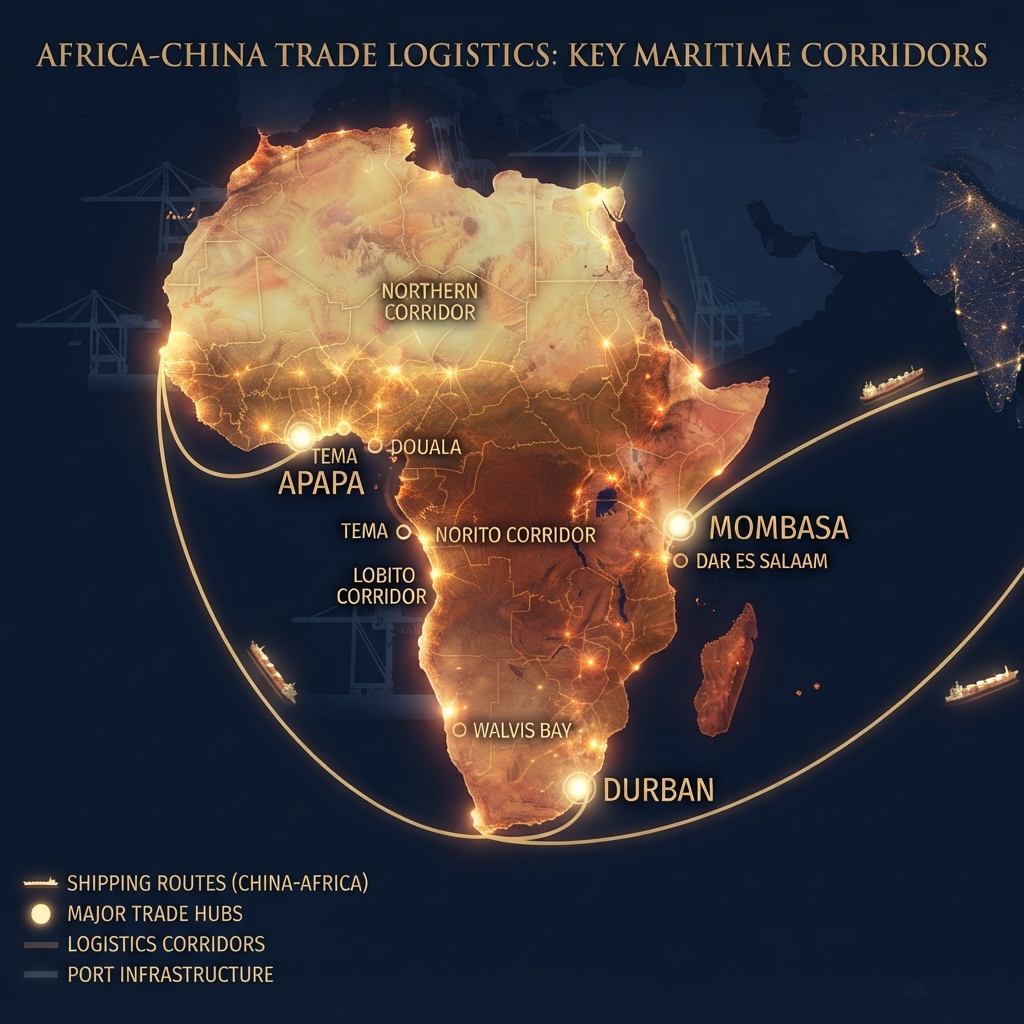
African importers who source from China and operate across multiple markets quickly discover that "shipping to Africa" is not one experience. It's at least two. The corridor from China to Lagos and Douala is a fundamentally different logistical world from the corridor to Mombasa and Dar es Salaam — different transit times, different pre-import requirements, different port realities, and different clearance timelines.
Understanding those differences isn't just interesting geography. It shapes booking strategy, budget planning, and delivery commitments to end clients.
Transit Times: East Africa Has the Distance Advantage
The routing explains the gap. Ships from China to East Africa cross the Indian Ocean — a direct path that doesn't require a Suez Canal transit or Atlantic routing. Ships to West Africa traditionally route through the Suez Canal, across the Mediterranean, and down the Atlantic coast — roughly 12,000 nautical miles to Lagos versus 7,000 to Mombasa.
| Metric | West Africa | East Africa |
|---|---|---|
| Direct transit from China | 28–38 days | 20–26 days |
| Via hub transshipment | 35–48 days | 24–34 days |
| Key ports | Lomé, Douala, Apapa, Tin Can, Abidjan | Mombasa, Dar es Salaam |
| Main transshipment hub | Tanger Med | Port Klang / Colombo |
| Key pre-departure documents | ECTN/BESC, Form M (Nigeria) | PVoC (Kenya, Tanzania) |
| Typical clearance time | 5–14 working days | 4–9 working days |
⚠️ Watch Out — Red Sea disruptions have narrowed the transit advantage East Africa would otherwise have. When vessels reroute via the Cape of Good Hope to avoid Red Sea security risks, West Africa transit times extend to 38–55 days as ships must continue north up the entire Atlantic coastline after rounding the Cape. The East Africa impact is less severe because Indian Ocean routing is unaffected. During periods of Red Sea disruption, the gap between East and West Africa transit widens considerably.
Documentation and Pre-Import Requirements
This is where the two corridors diverge most sharply. West Africa — particularly Nigeria — has the most layered pre-import documentation requirements of any China-Africa trade lane. East Africa's requirements are simpler in structure but still carry mandatory pre-departure steps for regulated goods.
-
West Africa (Nigeria specifically) requires Form M obtained through a Nigerian bank before shipment, SONCAP for regulated goods, and NAFDAC registration for food, drugs, and cosmetics — all before the vessel sails. The ECTN/BESC is required for Cameroon and most other ECOWAS markets. Let's not forget the Certificate of Conformity (ANOR) required in Cameroon.
-
East Africa requires PVoC (Pre-Verification of Conformity) certification for regulated goods entering Kenya, Tanzania, Uganda, Rwanda, and Ethiopia. This involves a factory inspection in China by an approved body before loading — similar in principle to SONCAP but covering different product categories and administered by different approved companies.
For a full breakdown of every pre-departure requirement by market, see: Pre-Import Verification Schemes: What You Must Know.
Port Environments
-
West Africa — Port congestion is a structural challenge at Lagos (Apapa and Tin Can Island) and periodically at Lomé and Douala. A single-road access corridor to the Lagos port complex creates the container truck queues that have become one of the most consistent inefficiencies on the corridor. Terminal free time is often consumed by clearance before collection is even possible.
-
East Africa — Mombasa and Dar es Salaam have both benefited from infrastructure investment and digital customs system upgrades in recent years. Congestion exists but is generally less severe than Lagos. Kenya's SGR rail connection from Mombasa to Nairobi provides an alternative to road for inland movement that doesn't exist in comparable form on the West Africa corridor.
👉 Pro Tip: If you're expanding from one corridor to the other, resist the temptation to apply the same planning assumptions. An importer accustomed to Mombasa clearance timelines will be surprised by Lagos if they plan on the same schedule. An importer moving from Lagos to Mombasa will find the documentation process simpler but the inland routing decisions more complex. Plan each corridor on its own terms — and engage a local customs broker before the first shipment, not after. See: How to Choose a Reliable Customs Broker in Africa.
本文目前仅提供英文版本,中文翻译即将上线。
Shipping to West Africa, East Africa, or both?
ChinAfrika Logistics Limited covers both corridors with in-market broker relationships across West and East Africa. Get a quote specific to your destination.
Get a Quote →Last reviewed: June 2026 · Category: Regional Focus
Related articles: Shipping to Nigeria · Importing into Cameroon · Mombasa vs Dar es Salaam · Pre-Import Verification Schemes